


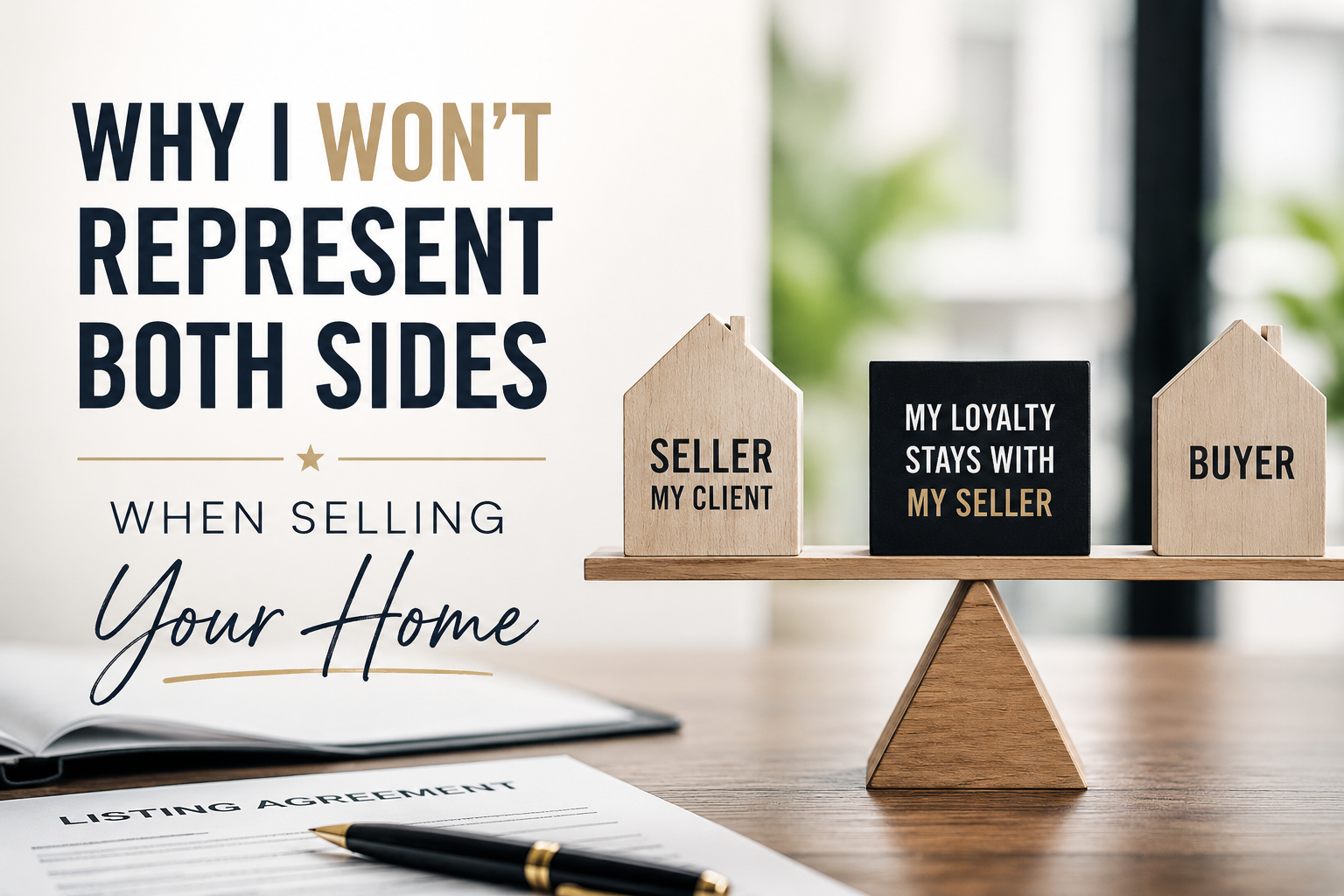
Why I Won’t Represent Both Sides When Selling Your Home
If you hire me to sell your home, you deserve to know exactly where my loyalty sits.
For me, that answer is simple:
With my seller.
In Texas real estate, intermediary is legal and commonly used—but not all intermediary situations look the same.
In larger brokerages, it’s common for intermediary to occur with appointed agents—meaning one agent represents the seller, another represents the buyer, and the broker serves as the intermediary.
That’s very different from an agent personally serving as the intermediary between both buyer and seller.
That second scenario?
That’s where I draw the line.
You Can’t Fully Represent Both Sides
Real estate negotiations are not neutral.
A seller wants the highest price, strongest terms, least risk, and the smoothest path to closing.
A buyer has a completely different set of interests.
Better price. Better terms. More concessions. Maximum protection.
So when one agent tries to “represent” both sides equally… who is truly being advised?
That’s the issue for me.
If You Hire Me to Sell Your Home…
You’re not hiring a neutral party.
You’re hiring an advocate.
When my seller hires me, they are trusting me to protect their interests, guide them through negotiations, point out risks, and help them make strategic decisions.
If I personally become the intermediary between buyer and seller, that changes.
I can no longer fully advocate the same way because my role becomes restricted.
And I’m simply not willing to put my seller in that position.
My Seller Hired Me for Advice—Not Neutrality
My job is not just unlocking doors and filling out paperwork.
My job is strategy.
That means helping my seller understand:
- Whether an offer is actually strong
- What terms could create risk
- Where negotiation leverage exists
- What inspection requests are reasonable
- When pushing back makes sense
- When accepting a deal is the smarter move
If I become intermediary, my ability to advise becomes limited.
And if my seller hired me to protect their best interests, I’m not willing to put myself in a position where I can’t do that fully.
What Happens If a Buyer Calls on One of My Listings?
This is where my process differs from a lot of agents.
If a buyer reaches out directly about one of my listings:
First: They Need to Be Qualified
I do not walk random buyers through my seller’s home.
Before any showing, I require:
- A lender pre-approval letter or
- Proof of funds for cash buyers
My seller’s home is not a public attraction.
If someone wants access, they need to be in a position to actually buy.
Second: Transparency Comes First
If an unrepresented buyer wants to make an offer on my listing, I make one thing very clear:
I represent the seller.
Not them.
That means my fiduciary duty remains with my seller client.
I can work with an unrepresented buyer to present an offer while remaining clear that my fiduciary duty is to my seller, but I am not acting as that buyer’s advocate.
If a buyer wants their own representation—and many should—I’m happy to refer them to another agent so they have someone fully protecting their interests too.
Is This the Common Approach?
Honestly? No.
Plenty of agents handle both sides. Texas law allows intermediary. I don't.
This is simply not how I choose to run my business. That’s a business decision rooted in how seriously I take fiduciary responsibility.
Because I believe my clients deserve full advocacy—not divided loyalty.
Why Sellers Should Care
When you hire a listing agent, you should ask:
“If a buyer comes directly to you, who are you representing?”
Because the answer matters.
My answer is simple:
The seller who hired me.
Always.
Check out this article next